3Commas review: position control before bot performance
A document-based assessment of bot authority, shutdown actions, exchange reconciliation and configuration evidence.
Review the bot family, not the brand alone
3Commas is assessed here as exchange-connected automation, not a measured source of profitable calls. Start with the exact bot family, version and connected exchange. A Signal Bot, grid configuration and externally triggered instruction can have different controls. Save that identity beside the settings you intend to test.
This desk has not connected an exchange account or commissioned a security assessment. The useful buying question is whether you can explain every action the chosen configuration is allowed to take. A feature list cannot answer whether its market rule survives costs or whether your account can tolerate its exposure.
A tracking action is not an exchange exit
The current official Positions Tab documentation distinguishes a market close from unlinking a position and stopping its tracking. The latter does not send an exchange order. That is a narrow interface fact, not a conclusion about every shutdown command in every bot. Follow the documentation for the exact version.
Write separate procedures for preventing new entries, cancelling resting orders, reducing or closing a position and revoking access. Never infer that a disappearing dashboard row means the exchange is flat. Record an exchange acknowledgement and reconciled position quantity for any action intended to change exposure.
A fictional shutdown drill
Imagine a bot displays a two-unit long position while a separate buy order for one unit rests at the exchange. Removing the displayed position from tracking leaves the exercise unresolved: neither the two-unit holding nor the resting order has been proven closed. If the pending order later fills, exposure could become three units under this simplified scenario.
A rehearsal should therefore name both objects, their identifiers and the intended disposition. Test the runbook without real funds where a suitable simulation is available, then document what simulation cannot reproduce. This example describes a state-control mistake; it is not an incident attributed to 3Commas.
Permissions and recovery need their own record
Use the official application and exchange permission documentation to identify the minimum authority required for the selected function. Keep API secrets out of worksheets and screenshots. Document revocation, credential expiry and the verified support route before delegating execution. Permission to trade can change account risk even when withdrawal authority is absent.
After an interruption, compare exchange positions and orders with the last acknowledged bot event. Do not replay an old entry merely because a local log calls it unprocessed. The current account may already contain its effect, and the market condition that originally justified it may no longer hold.
Freeze the configuration for an economic test
A reproducible experiment needs the entry rule, exit rule, allocation, maximum simultaneous exposure, data timestamps and treatment of failed orders. Save parameter changes as new versions instead of retroactively assigning the final settings to earlier results. If a strategy uses averaging, record every planned additional order and its effect on the total position.
Separate platform subscription cost from exchange charges and any paid strategy or signal source. A backtest screen or shared deal image does not supply the complete population of settings tried. Platform functionality, seller evidence and subscriber execution remain three different assessments.
A scoped purchase condition
Proceed only when you can state which account actions you are authorising and reproduce the emergency procedure from current documentation. Ask for the current plan limits and exchange compatibility directly; this page does not freeze a price or promise a supported venue. Record the date and document version in your comparison.
No paid-bot performance verdict, observed uptime rate or blanket security approval follows from this review. The practical output is a configuration and authority record, with unresolved questions attached. An automation service can be useful operationally while the proposed trading hypothesis still has no adequate validation evidence.
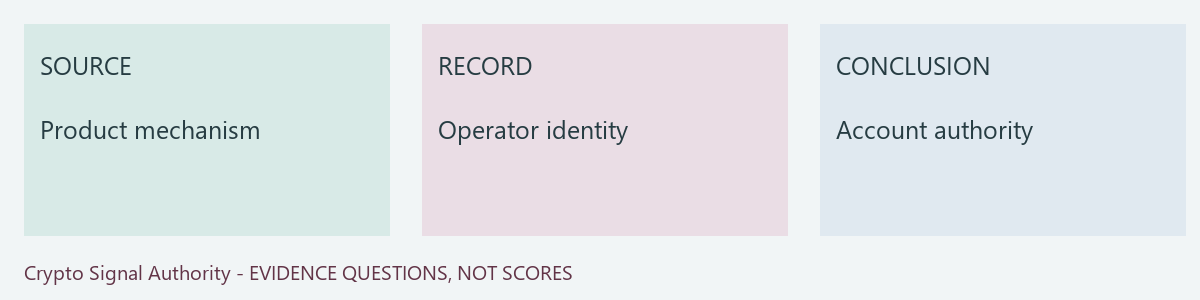
Evidence handoff
| Check | Record | Boundary |
|---|---|---|
| Stop tracking | Documented tracking action | No exchange exit follows from that action alone |
| Close position | Exchange acknowledgement and quantity | A click is not a confirmed fill |
| Recover connection | Positions and outstanding orders | Do not blindly replay stale entries |
 Blank evidence CSV
Column definitions: bot_family, version, exchange, account_alias, position_id, order_id, action_requested, event_time_utc, acknowledgement_id, position_before, position_after, resting_orders_after, permission_scope, document_reference.
No example trade or user record is stored in the download. Keep credentials and personal account identifiers out of shared copies.
What the new packet adds, and what it does not
The sixteen-event packet's duplicate and cancellation are authored, not a successful Signal Bot integration. The current review's documented action limits remain intact. A genuine test would reconcile original instruction, venue acknowledgement, quantities and remaining positions with selected configuration. API authority and emergency behavior cannot be certified from the count lens. No actual bot instance, key, paid subscription or account result was supplied for this expansion.