Coin Bureau review: education, commentary and trade evidence
Evaluate the exact information or membership offer without converting commentary, portfolios or audience reach into signal performance.
Identify the information you are buying
Coin Bureau is reviewed here as a crypto information and education publication. A public article, video, membership feed and third-party deal are separate objects. Start with the exact URL or membership product and describe what you expect to receive. Do not assume that every opinion is a timestamped instruction to open and close a position.
The relevant quality questions concern source attribution, uncertainty, corrections and the distinction between analysis and promotion. Subscriber counts or production polish do not establish an executable trading record. This desk has not completed a paid-membership experiment or evaluated every article in its archive.
The source sets a narrower scope
Coin Bureau's public-site terms describe information rather than investment advice and disclose participation in affiliate programmes. They do not identify the arrangement behind every individual article. Check the disclosure attached to the specific material. The previously indexed Club terms redirected to a migration page when opened during this review, so current membership conditions remain to be confirmed.
Treat any team-portfolio display as a labelled information object, not an independently reconciled subscriber account. If a page presents a trade-related assertion, ask for its dated original wording and the evidence supporting it. Public-site terms explain a narrower boundary; they do not establish current paid-membership conditions or verify each financial claim.
Turn a commentary item into an inspectable claim
For a fictional research exercise, an article says a token's adoption is improving. Split that proposition into the observed metric, source date, attribution and alternative explanations. Increased transfers might reflect internal movements or incentive activity rather than additional independent users. A reader needs those definitions before drawing a market conclusion.
Keep the factual observation, the author's interpretation and your proposed trading rule in separate columns. The exercise does not attribute this statement to Coin Bureau. It demonstrates why an interesting narrative cannot supply entry timing, a stop, allocation or an exit policy by itself.
Compare learning value with signal value
A learning resource can be useful even when it cannot be scored as a signal provider. Assess whether it explains a mechanism clearly, links original material, names assumptions and acknowledges what is unknown. For a purchase, inspect a permitted sample and the current membership scope rather than guessing from a public headline.
If your goal is a complete call ledger, ask whether that is actually offered. Do not deduct points merely because an education publication does not supply an unrelated execution product. Equally, do not award a trading-performance score because educational explanations are accessible or a presenter seems confident.
Keep incentives and updates beside the claim
Record sponsorship and referral disclosures associated with the exact item you are evaluating. An affiliate relationship can be material without making every observation false. The useful question is what commercial incentive exists and whether the claim remains reproducible independently of the destination link. Do not infer an undisclosed payment from an ordinary citation alone.
Preserve the publication and amendment dates. A revised explanation after a market event should not be presented as an unchanged forecast made before it. If historical wording is unavailable, label the timing question unresolved instead of choosing the version that appears most prescient.
A decision that matches the product
For an education purchase, set a learning objective such as explaining custody choices or reproducing a data definition. For a signal purchase, require an actual described signal product and an inspectable population. Those are different decision records, and neither is resolved by a single universal five-star verdict.
No reader-return estimate, accuracy percentage or endorsement of a partner follows from this page. The assessment offers a claim-checking workflow and a source boundary. Its missing evidence remains paid-access scope, item-level review coverage and any trading-outcome records that a particular offer may separately assert.
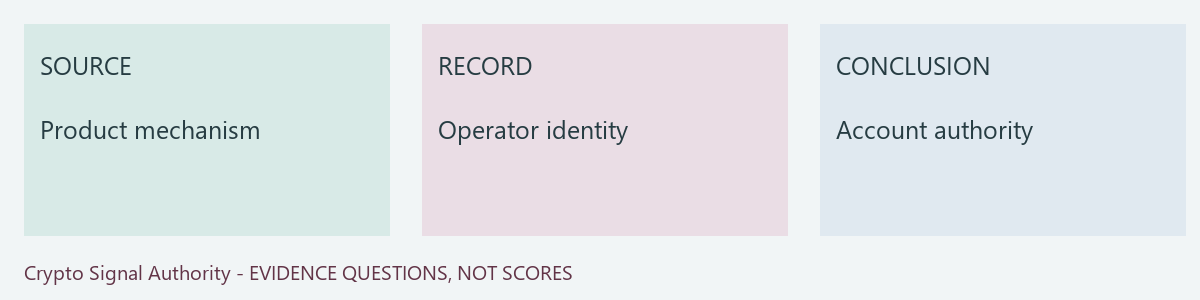
Evidence handoff
| Check | Record | Boundary |
|---|---|---|
| Observation | Original metric and definition | A transfer count is not a trade instruction |
| Interpretation | Reasoning and alternatives | Confidence is not measured accuracy |
| Purchase | Exact membership scope and terms | Education and execution need different evidence |
 Blank evidence CSV
Column definitions: item_url, product_name, published_at, amended_at, claim_text, observation_source, source_cutoff, metric_definition, interpretation, alternative_explanation, commercial_disclosure, missing_evidence, learning_output.
No example trade or user record is stored in the download. Keep credentials and personal account identifiers out of shared copies.
What the new packet adds, and what it does not
A commentary publication is not converted into a paid signal room because an article discusses price. Its disclosed affiliate context needs the exact source version, while a popularity metric cannot establish trading performance. The new on-chain and screenshot guides deepen these distinctions without claiming an actual content-to-trade test. No subscriber sample or independently measured recommendation return is supplied. A useful information review can remain separate from actionable instruction and exchange-execution assessments.