Crypto Performance Claims: Which Population Produced the Number?
Separate wallet movement, strategy calls, closed positions and subscriber accounts before interpreting a return or win-rate headline.
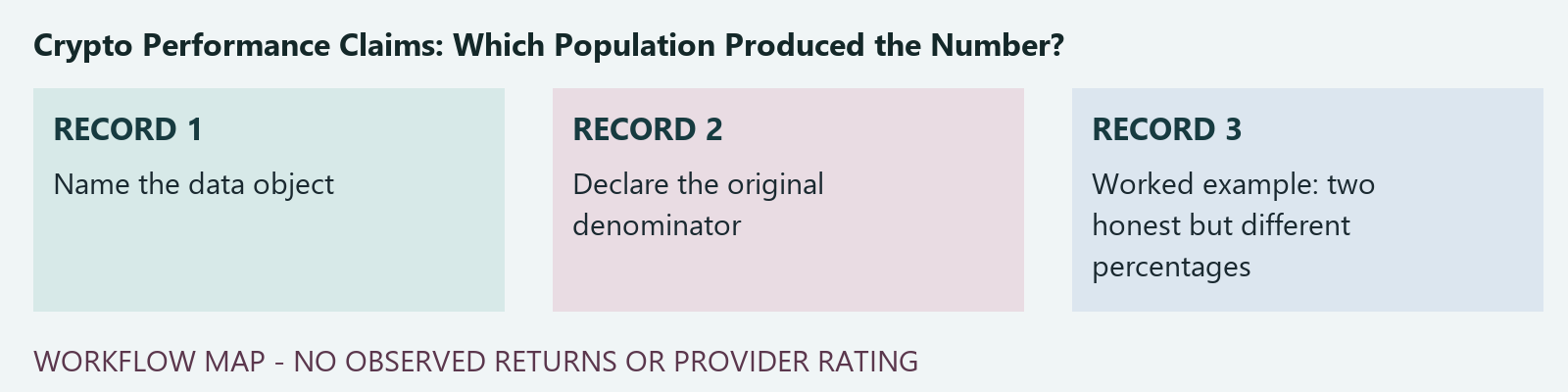
Name the data object
Identify whether the evidence is a wallet transaction list, exchange account, published call archive, research model or customer account. These objects can intersect without being equivalent. An on-chain transfer may move capital between addresses rather than realise a trade. An exchange statement can include off-chain fills not visible in a wallet explorer. A crypto signal archive can contain instructions without any execution. Write the object and its limits before asking whether a performance number is verified.
Declare the original denominator
Record every original call ID during a specified window and classify final states under an explicit rule. Closed winners, closed losses, flat outcomes, open positions, cancelled calls and unfilled conditions should not be casually mixed. Count changes as versions of the original call unless the policy defines them as new instructions. A published win rate needs a stated population; an impressive screenshot cannot recover it. Do not round a percentage into an exact winner count when the underlying numerator was never supplied.
Worked example: two honest but different percentages
Invent twenty original calls: nine closed winners, six closed losses, two flat closes and three open positions. Winners divided by the fifteen non-flat closes gives 60%, while winners divided by all seventeen closes gives approximately 52.94%. Neither denominator includes the three unresolved open positions as final outcomes. This example does not recommend one convention as universally correct. It shows why a review must publish its grouping and flat-trade rule before comparing the figure with another provider or extending it to account profitability.
Keep capital and valuation in view
A sum of percentage moves across calls is not automatically a compounded portfolio return. Ask about weights, overlap, funding, cash flows and marked open exposure. Different collateral and settlement assets introduce additional unit questions. Preserve the account currency and conversion convention. A complete original-call population can still be insufficient for reconstructing a subscriber account. Do not fill missing capital allocations with equal weights unless that is a declared hypothetical scenario, clearly separate from the provider's actual reported methodology.
Cryptographic records answer narrower questions
Digest and timestamp checks can help examine specified content and a verifiable time boundary. They do not make an outcome label true or prove that losing calls were included. The OpenTimestamps client and NIST hash specification define mechanisms, not investment-performance assurance. Retain the preimage, covered fields, receipt status and independent verification output. A wallet transaction or blockchain reference attached to a chart should not be treated as proof of the chart's complete economic interpretation.
Publish a claim-to-record map
For each headline, list the claimed object, supporting source, calculation convention and unresolved evidence. Documentation-only profiles should not suggest paid trials or independently reconstructed returns. A consumer can still compare access, transparency and the questions an operator answers without inventing a measured ranking. This chapter provides a population review protocol and fictional arithmetic, not a new crypto industry survey. The valuable outcome is a narrower, reproducible claim: the reader understands exactly what the number does and does not describe.
Decision record
| Question | Record to retain | Decision boundary |
|---|---|---|
| Object | Wallet, exchange, model or subscriber-account identity | A transfer list is not automatically a trade ledger |
| Win rate | Original IDs, final states and flat-trade policy | A percentage needs its actual denominator |
| Return | Weights, overlap, currency and cash-flow convention | Summed call moves are not portfolio return |
| Proof | Exact bytes, receipt state and covered fields | Content existence does not establish economic completeness |
Blank working record
The worksheet contains column headings only. Enter your own dated observations, keep absent evidence marked unknown, and do not treat the file as certification.
 Download worksheet (CSV)
Primary references
- OpenTimestamps: official client and verification
- NIST: Secure Hash Standard
- CFA Institute: GIPS standards and scope
These documents support mechanisms and source definitions, not a tested trading result or a recommendation. Accessed 9 October 2026. The decision workflow and invented examples above are editorial exercises.
Keep reading
Publication methodology | Working glossary | Source and correction policy
The new packet makes the population layers inspectable
The declaration, listed rows, state classification and closed subset now have complete authored examples. Sixteen events attach to ten ideas without inflate the denominator. Two missing identifiers remain absent and one listed row remains unknown. Seven arithmetic cases include an empty batch, no closed ideas and never-filled events only. Each rate names its denominator, and zero denominators serialize as null. This connects the original population guide to inspectable teaching records without claiming genuine paid-room observation or a measured market-wide return.